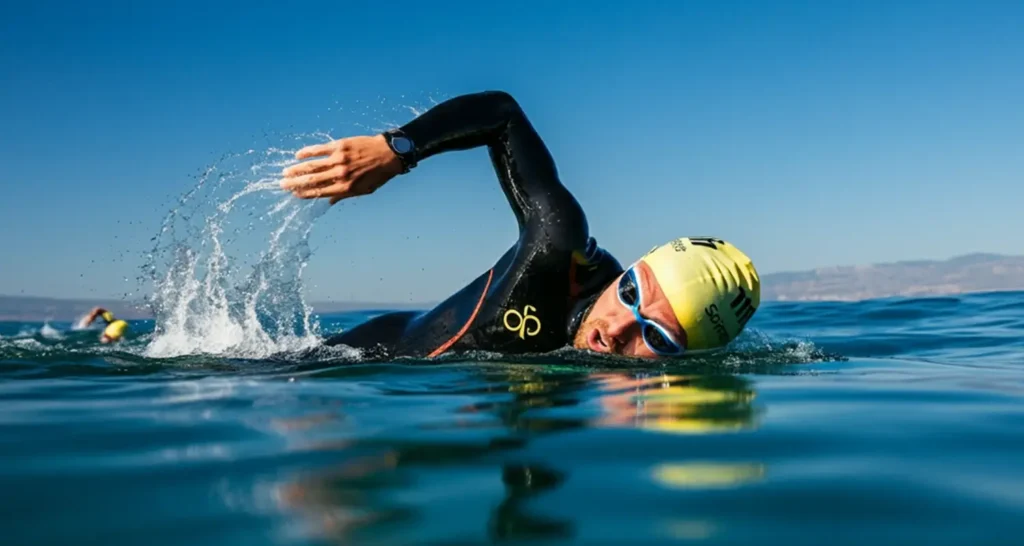
Every season, athletes get pulled aside at check-in because of a wetsuit — too thick, too warm for the water temperature, or not allowed at all. The rules are simple once laid out, but they live scattered across Ironman, USA Triathlon and World Triathlon rulebooks. Here is the whole picture in one place: when wetsuits are legal, optional, or banned, and what happens to your race if you wear one anyway.
The temperature cutoffs that decide everything
| Water temperature | Ironman / Ironman 70.3 (age group) |
|---|---|
| Up to 24.5°C / 76.1°F | Wetsuit legal |
| 24.6–28.8°C / 76.2–83.8°F | Optional but non-competitive: you may wear one, but you give up awards, podium and World Championship slots |
| Above 28.8°C / 83.8°F | Wetsuit banned for everyone |
USA Triathlon age-group rules are close but not identical: wetsuits are legal up to 78°F (25.5°C), wearable-but-ineligible-for-awards up to 83.9°F, banned above 84°F. Professionals race under tighter cutoffs (wetsuits banned above roughly 21.9°C / 71.5°F in Ironman pro fields). Always confirm at athlete briefing — the official measurement is taken on race morning, and borderline races genuinely flip either way.
Thickness and design rules
- 5 mm maximum thickness anywhere on the suit — every major federation agrees. Mainstream race wetsuits (1.5–5 mm panels) are fine; some thick open-water swimming suits are not.
- Full sleeves are legal everywhere in triathlon. Sleeveless is a choice, not a rule.
- No propulsion devices: fins, paddles, gloves and booties are banned in legal-temperature races (neoprene caps and booties may be allowed in very cold water at the race director’s discretion).
- Swimskins (non-neoprene speedsuits) are the fast option for non-wetsuit swims and are legal as long as they are textile.
Cold-water limits and shortened swims
Below about 16°C / 60.8°F, wetsuits become mandatory for age groupers in Ironman events. Keep going down and race directors start shortening swims; near 12°C the swim is typically cut or cancelled. If your race is a known cold one (early-season lakes, sea swims), train in your wetsuit in similar temperatures — the first cold-water minute is a skill, and our open-water technique guide covers the breathing drill that controls it.
What this means when you buy
Buy for the water you actually race in. Athletes racing early-season or northern races should prioritize warmth and flexibility (full-sleeve, quality neoprene); athletes racing warm venues mainly need a suit for the occasional legal swim plus a good swimskin. Our tested picks are in the best triathlon wetsuits guide.
FAQ
What happens if I wear a wetsuit in the optional zone?
You start in a separate wave or at the back, you finish officially, but you are not eligible for age-group awards or championship slots. For many first-timers that trade is worth it for the confidence and buoyancy.
Can I cut my wetsuit sleeves or ankles?
Yes — trimming for easier removal is legal and common. Just do not add anything to the suit.
Do wetsuits actually make you faster?
For most age groupers, meaningfully — typical savings run several seconds per 100 m thanks to buoyancy, more for weaker swimmers. That is exactly why the rules cap when you can use one.
Is the 70.3 swim cutoff different in a wetsuit race?
No — the 1:10 swim cutoff applies either way; the wetsuit just makes it easier to beat.